

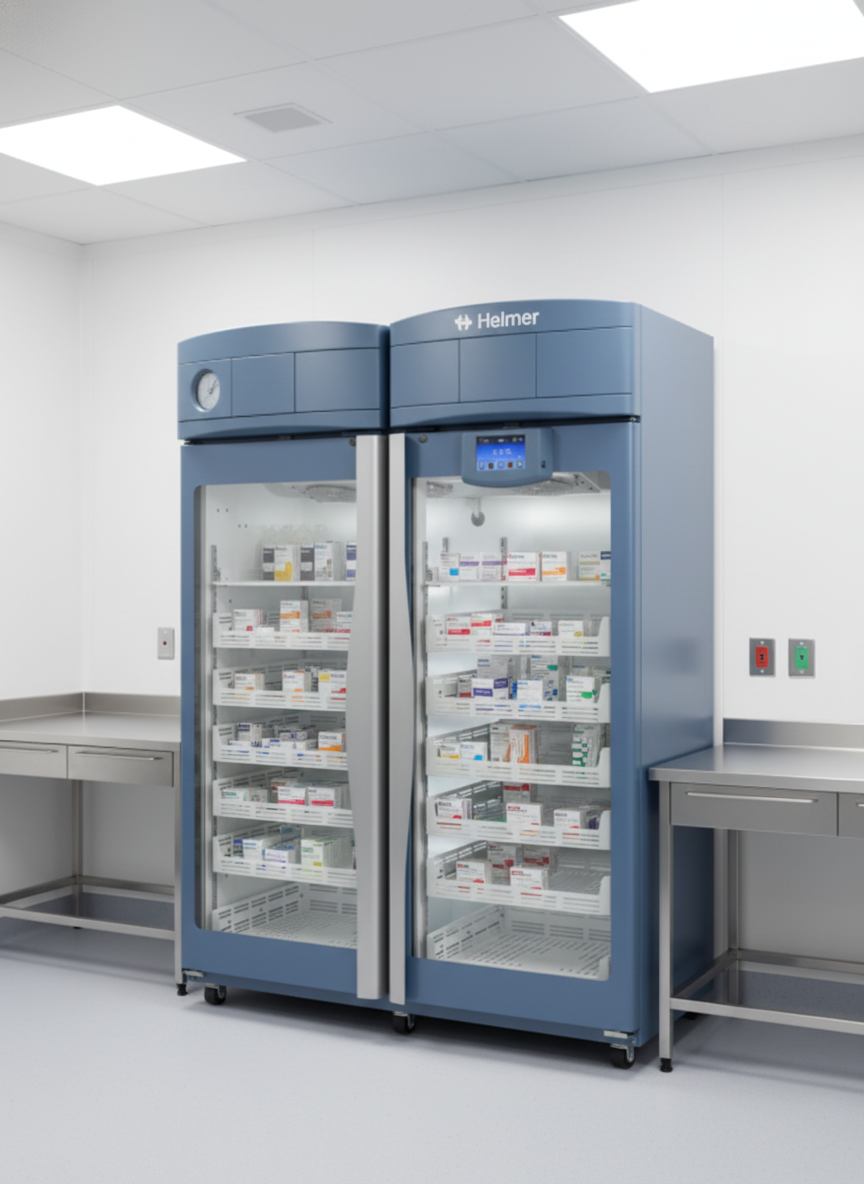
 When a community hospital pharmacy loses thousands of dollars worth of specialty medications due to a temperature excursion, the financial impact is significant. But the real cost, delayed patient treatments and potential compromises in care, can't be measured in dollars.
Choosing the right pharmacy refrigerator isn't just an equipment decision. It's a patient safety decision. This guide covers the five critical features that separate reliable medical-grade units from costly mistakes, helping you protect both your medication inventory and the patients who depend on it.
Why Medical-Grade Pharmacy Refrigeration is Essential
Medications and vaccines require precise storage temperatures between 2°C and 8°C (36°F to 46°F). This isn't a suggestion; it's a regulatory requirement enforced by the CDC, FDA, and Joint Commission, and mandated by USP <797> standards for compounding pharmacies.
Standard consumer refrigerators cannot maintain these tolerances. They experience temperature fluctuations of ±3°C to ±5°C, create cold spots near cooling elements, and lack the monitoring capabilities required for regulatory compliance. A single temperature deviation can compromise medication efficacy, forcing you to discard inventory and potentially delaying patient care.
Medical-grade pharmacy refrigerators are engineered specifically for temperature-sensitive materials. They provide precision control, monitoring capabilities, and compliance documentation that healthcare facilities need. Understanding the critical features that deliver these capabilities helps you make an investment that protects both your budget and your patients.
The 5 Most Critical Features
Feature #1 – Precise Temperature Control
Temperature precision is non-negotiable. Your pharmacy refrigerator should maintain a uniform temperature throughout the chamber, not just at a single sensor location, but at every shelf level, from front to back.
Look for units with digital microprocessor controls rather than analog thermostats. Microprocessor controllers continuously adjust cooling to maintain stability even when ambient room temperatures fluctuate. Advanced forced-air convection refrigerators prevent temperature dead zones, ensuring consistent conditions for every medication stored.
Impact for Your Pharmacy: Precision control protects the medications your patients depend on while eliminating medication loss from temperature excursions and ensures compliance with USP <797> and other regulatory requirements.
Feature #2 – Alarm Systems & Monitoring
Multiple alarm levels protect your inventory. Essential alarm features include:
- Audible and visual alarms that activate when the temperature deviates from the set point
- Door-ajar detection preventing gradual temperature drift from incomplete closure
- Power failure alerts enabling rapid response to protect medications during outages
- Continuous data logging creating auditable temperature records for regulatory inspections
In addition to standard equipment alarms, remote monitoring systems can provide email, SMS, or mobile app notifications, providing 24/7 temperature awareness. Pharmacy refrigerators should be compatible with such monitoring systems.
Impact for Your Pharmacy: Multi-level alarms are required for safe medication and vaccine storage. Automated data logging eliminates manual temperature recording and creating audit-ready compliance records.
Feature #3 – Capacity & Configuration
Right-sizing your pharmacy refrigerator prevents two common problems: overcrowding, which restricts airflow and compromises temperature uniformity, or excess capacity, which wastes space and energy.
Capacity Options:
- Countertop models (<4 cu ft): Ideal for small pharmacies or satellite medication rooms with limited space
- Under-counter units (3-6 cu ft): Maximize floor space in crowded pharmacy work area, help with medication management throughout the hospital
- Mid-size refrigerators (14-16 cu ft): Standard choice for most hospital pharmacies
- Full-size units (27-45+ cu ft): High-volume facilities managing extensive specialty medication inventories
Door Type Considerations: Glass doors provide inventory visibility, enabling quick medication checks without opening the door and disrupting the temperature. Solid doors offer superior light protection for photosensitive medications and typically provide better energy efficiency.
Impact for Your Pharmacy: Proper capacity planning ensures adequate airflow for temperature uniformity while avoiding wasted space. Consider building in a growth buffer of 20-30% when sizing to support your expanding patient care needs.
Feature #4 – Energy Efficiency
ENERGY STAR® certified units reduce operating costs while meeting medical-grade performance standards. Look for features that minimize energy consumption without compromising temperature control:
- LED lighting that generates minimal heat compared to incandescent bulbs
- High-efficiency insulation maintains temperature with less energy
- Optimized compressor systems designed for 24/7 operation
Equally important is temperature holdover capability, how long a unit maintains proper temperature after power loss. Quality medical-grade refrigerators use superior insulation and thermal mass to hold temperature for extended periods during utility interruptions. This built-in protection safeguards inventory while you respond to power outages. Some models also offer battery-powered display systems that continue showing internal temperature even when power is lost, helping monitor conditions and make informed decisions about inventory.
Impact for Your Pharmacy: Energy-efficient operation reduces utility costs over the 10-year lifespan of the unit. Superior temperature holdover protects medications during power outages, preventing inventory loss and ensuring the treatments remain available when needed most.
Feature #5 – Lock & Security Features
Secure medication storage isn't optional; many state pharmacy boards and healthcare accreditation bodies require it. Lockable doors prevent unauthorized access, reduce diversion risk, and ensure controlled medication handling.
Security features to evaluate:
- Key locks for simple access control
- PIN or electronic locks for audit trails and access logging
- Integration options with facility badge access systems
Beyond regulatory compliance, locks protect expensive specialty medication inventory and provide clear accountability for staff access.
Impact for Your Pharmacy: Lockable storage meets regulatory requirements while protecting high-value inventory. Access control reduces liability and supports medication safety protocols that protect both your facility and your patients.
Understanding Total Cost of Ownership
Purchase price represents only a fraction of your true investment. Total cost of ownership over a 10-year lifespan includes initial purchase, ongoing maintenance, energy consumption, and most critically, the risk of medication loss.
What Drives Long-Term Value:
Medical-grade refrigerators aren't commodities. Price differences between entry-level and premium units reflect fundamental differences in engineering, materials, and reliability:
- Build quality and lifespan: Premium units engineered for 10 years of continuous operation vs. 5-7 years for basic models
- Temperature precision and uniformity: Superior insulation, advanced circulation systems, and microprocessor controls prevent temperature variations that compromise medication efficacy
- Reliability and uptime: Higher-quality compressors and components mean fewer service calls and less operational disruption
- Compliance documentation: Comprehensive monitoring and data logging systems that satisfy regulatory requirements without additional investment
The Real Cost of Equipment Failure:
A single temperature excursion at a hospital pharmacy can result in:
- $5,000-$15,000 in medication waste (specialty drugs, biologics, vaccines)
- Delayed patient treatments while inventory is replaced
- Staff time investigating and documenting the incident
- Potential regulatory citations during inspections
- Risk to patient safety and facility reputation
Investment Considerations:
Rather than focusing solely on initial price, evaluate:
- Manufacturer reputation: How long have they specialized in medical-grade refrigeration?
- Installed base: How many healthcare facilities trust this manufacturer?
- Service infrastructure: What's the average response time for service needs?
- Warranty coverage: What's included and for how long?
- Energy efficiency: ENERGY STAR® certified units can save 10-15% annually on operating costs
Making the Business Case:
Medical-grade refrigeration isn't an expense; it's risk mitigation, protecting the most valuable assets: medication inventory and patients. When building a business case for capital approval, emphasize that one prevented temperature excursion can justify years of investment in quality equipment. For pharmacies managing specialty medications, biologics, or vaccines valued at thousands of dollars per dose, the cost of inadequate refrigeration far exceeds the price difference between basic and premium equipment.
Focus on selecting equipment from manufacturers who specialize in healthcare applications, understand regulatory requirements, and demonstrate a proven track record in similar environments.
Making Your Decision
Before requesting quotes, complete this assessment:
- Calculate your current medication inventory volume and project a 2-3 year growth
- Review your specific regulatory requirements (USP <797>, state board, accreditation standards)
- Evaluate your space constraints and workflow patterns
- Determine essential alarm and monitoring capabilities for your facility
- Establish your budget for both initial investment and ongoing maintenance
Compare specifications carefully. The lowest-priced unit rarely delivers the lowest total cost of ownership. Focus on reliability, compliance features, and the support infrastructure the manufacturer provides.
Request references from similar pharmacies. Ask about real-world temperature performance, service responsiveness, and whether the equipment has met their regulatory compliance needs during inspections.
Protecting What Matters Most
Pharmacy refrigerators protect more than medications; they safeguard the treatments patients depend on.
When evaluating pharmacy refrigeration solutions, prioritize precise temperature control, comprehensive alarm systems, appropriate capacity, energy efficiency, and secure access control. Together, they provide the foundation for medication safety and regulatory confidence.
Helmer Scientific has spent over 40 years engineering precision storage solutions trusted by more than 900 hospitals nationwide, because we understand that every medication you protect represents a patient counting on you. Partner with specialists who share your commitment to the patients you serve.